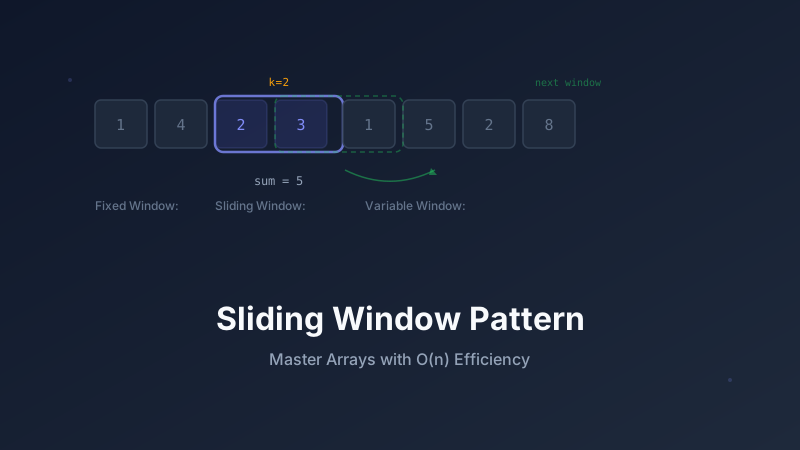
Mastering the Sliding Window Pattern
Mastering the Sliding Window Pattern
Sliding window is the go-to pattern when you need to operate on a contiguous subarray or substring. Instead of recalculating from scratch every time, you slide a window over the array and update results incrementally.
When to Use It
Use sliding window when the problem asks about:
- Maximum/minimum sum of a subarray of size
k - Longest/shortest substring with a certain property
- Number of subarrays satisfying a condition
- Contiguous elements with constraints
Fixed-Size Window Template
typescriptfunction maxSumSubarray(nums: number[], k: number): number { let maxSum = 0 let windowSum = 0 for (let i = 0; i < nums.length; i++) { windowSum += nums[i] // add new element // when window reaches size k if (i >= k - 1) { maxSum = Math.max(maxSum, windowSum) windowSum -= nums[i - k + 1] // remove oldest element } } return maxSum }
Visualization
For nums = [1, 3, 5, 2, 8, 4], k = 3:
Window 1: [1 3 5] 2 8 4 → sum = 9
Window 2: 1 [3 5 2] 8 4 → sum = 10
Window 3: 1 3 [5 2 8] 4 → sum = 15  ← max
Window 4: 1 3 5 [2 8 4] → sum = 14
Variable-Size Window Template
Used for "longest substring with at most K distinct characters" type problems.
typescriptfunction longestSubstringKDistinct(s: string, k: number): number { const map = new Map<string, number>() let left = 0 let maxLen = 0 for (let right = 0; right < s.length; right++) { // expand window: include s[right] map.set(s[right], (map.get(s[right]) || 0) + 1) // shrink window while invalid while (map.size > k) { const leftChar = s[left] map.set(leftChar, map.get(leftChar)! - 1) if (map.get(leftChar) === 0) map.delete(leftChar) left++ } // window is valid now maxLen = Math.max(maxLen, right - left + 1) } return maxLen }
4 Classic Problems
1. Best Time to Buy and Sell Stock
typescriptfunction maxProfit(prices: number[]): number { let minPrice = Infinity let maxProfit = 0 for (const price of prices) { minPrice = Math.min(minPrice, price) maxProfit = Math.max(maxProfit, price - minPrice) } return maxProfit }
This is technically a one-sided window: we keep track of the minimum seen so far.
2. Longest Repeating Character Replacement
typescriptfunction characterReplacement(s: string, k: number): number { const count = new Map<string, number>() let maxFreq = 0 let left = 0 let maxLen = 0 for (let right = 0; right < s.length; right++) { count.set(s[right], (count.get(s[right]) || 0) + 1) maxFreq = Math.max(maxFreq, count.get(s[right])!) // window size - maxFreq = replacements needed while (right - left + 1 - maxFreq > k) { count.set(s[left], count.get(s[left])! - 1) left++ } maxLen = Math.max(maxLen, right - left + 1) } return maxLen }
3. Minimum Size Subarray Sum
typescriptfunction minSubArrayLen(target: number, nums: number[]): number { let left = 0 let sum = 0 let minLen = Infinity for (let right = 0; right < nums.length; right++) { sum += nums[right] while (sum >= target) { minLen = Math.min(minLen, right - left + 1) sum -= nums[left] left++ } } return minLen === Infinity ? 0 : minLen }
4. Permutation in String
typescriptfunction checkInclusion(s1: string, s2: string): boolean { if (s1.length > s2.length) return false const count1 = Array(26).fill(0) const count2 = Array(26).fill(0) for (let i = 0; i < s1.length; i++) { count1[s1.charCodeAt(i) - 97]++ count2[s2.charCodeAt(i) - 97]++ } let matches = 0 for (let i = 0; i < 26; i++) { if (count1[i] === count2[i]) matches++ } let left = 0 for (let right = s1.length; right < s2.length; right++) { if (matches === 26) return true const rightIndex = s2.charCodeAt(right) - 97 count2[rightIndex]++ if (count2[rightIndex] === count1[rightIndex]) matches++ else if (count2[rightIndex] === count1[rightIndex] + 1) matches-- const leftIndex = s2.charCodeAt(left) - 97 count2[leftIndex]-- if (count2[leftIndex] === count1[leftIndex]) matches++ else if (count2[leftIndex] === count1[leftIndex] - 1) matches-- left++ } return matches === 26 }
Fixed vs Variable Window
| Type | Use Case | Loop Structure |
|------|----------|----------------|
| Fixed | Known window size k | Single loop, remove i-k+1 |
| Variable | Constraint-based (e.g., at most K distinct) | Expand with right, shrink with left |
How to Recognize Sliding Window Problems
Ask these questions:
- Is it about a contiguous subarray/substring?
- Is there a size constraint (fixed or variable)?
- Can you update the result in O(1) when the window slides?
If yes to all three, sliding window is likely the answer.
Sliding window turns O(n²) brute-force problems into O(n) elegant solutions. The trick is knowing what to maintain as the window moves.