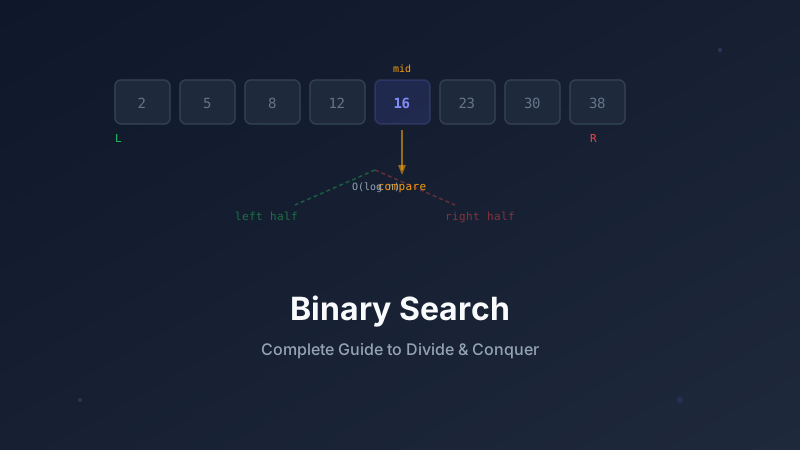
Binary Search: The Complete Guide
Binary Search: The Complete Guide
Binary search is one of the most common interview topics. It's simple in theory, but has surprising depth. This guide takes you from the basics to advanced variants.
Why Binary Search?
Binary search works on sorted arrays and runs in O(log n) time. Compared to linear search at O(n), it scales massively:
| Array size | Linear search | Binary search | |-----------|---------------|---------------| | 1,000 | ~1,000 ops | ~10 ops | | 1,000,000 | ~1,000,000 ops | ~20 ops | | 1,000,000,000 | ~1B ops | ~30 ops |
The Core Template
typescriptfunction binarySearch(nums: number[], target: number): number { let left = 0 let right = nums.length - 1 while (left <= right) { const mid = left + Math.floor((right - left) / 2) if (nums[mid] === target) { return mid } else if (nums[mid] < target) { left = mid + 1 } else { right = mid - 1 } } return -1 }
Why left + (right - left) / 2?
The naive mid = (left + right) / 2 can overflow in languages with fixed-width integers (C, Java, older C++). The safer form avoids it. In JS/TS it doesn't matter, but it's a good habit.
Variant 1: Find Leftmost / Rightmost
When duplicates exist, the basic template only finds an occurrence. To find the leftmost or rightmost:
typescript// Leftmost: first index where nums[i] >= target function lowerBound(nums: number[], target: number): number { let left = 0, right = nums.length while (left < right) { const mid = left + Math.floor((right - left) / 2) if (nums[mid] < target) left = mid + 1 else right = mid } return left } // Rightmost: last index where nums[i] <= target function upperBound(nums: number[], target: number): number { let left = 0, right = nums.length while (left < right) { const mid = left + Math.floor((right - left) / 2) if (nums[mid] <= target) left = mid + 1 else right = mid } return left - 1 }
Variant 2: Search on Answer
Some problems don't search an array — they search a range of possible answers.
Given
nworkers producingunits[i]items/day, find the minimum number of days to produce at leastmitems.
typescriptfunction minDays(units: number[], m: number): number { let left = 1 let right = Math.max(...units) * m // worst case while (left < right) { const mid = left + Math.floor((right - left) / 2) const total = units.reduce((sum, u) => sum + Math.floor(mid / u) * u, 0) if (total >= m) right = mid else left = mid + 1 } return left }
The trick: the answer space is monotonic — if we can do it in k days, we can do it in any k' >= k days.
Common Pitfalls
- Infinite loop: when
left == rightbut you keep looping. Always ensure the loop terminates. - Off-by-one:
left <= rightvsleft < right. Pick one and be consistent. - Empty array: handle
nums.length === 0first. - Integer overflow: use
left + (right - left) / 2. - Mid computation order:
Math.floor((left + right) / 2)can have precision issues in some languages.
Practice Problems
Here are 5 problems in increasing difficulty:
| # | Problem | Variant | |---|---------|---------| | 1 | LeetCode 704: Binary Search | Basic | | 2 | LeetCode 34: Find First and Last Position | Lower/Upper bound | | 3 | LeetCode 33: Search in Rotated Sorted Array | Modified array | | 4 | LeetCode 1539: Kth Missing Positive | Search on answer | | 5 | LeetCode 4: Median of Two Sorted Arrays | Advanced |
Mental Model
When you see a problem, ask yourself:
- Is the data sorted? → Binary search candidate.
- Is the answer space monotonic? → Binary search on answer.
- What are the boundaries? → Define
leftandrightprecisely before coding.
Binary search isn't just about arrays. It's a way of thinking: repeatedly halve the problem space until you converge on the answer.
Master this template and you'll recognize binary search problems in any disguise.